June - November 2024
Healthy Gaming Pilot: Mellor Community Primary School, Taylor Road Primary School, and Inglehurst Junior School
Key Findings:
The healthy gaming approach was piloted at three Primary Schools in Leicester, with the aim to address gaming-related harms among young people.
This community-based initiative focused on four pillars: Knowledge, Connection, Support, and Voice.
The pilot involved baseline surveys, healthy gaming workshops for students, parent information sessions, staff training, and the co-creation of a "healthier gaming contract."
25%
Were gaming for more than two hours per day
Advice from recognised bodies would suggest a healthy amount of gaming per day would be between 1-2 hours for primary school aged children. The healthy gaming workshops address this with the students, encouraging screen breaks and activities away from their gaming platforms.
15%
Engaged with 18+ rated games
Whilst most students engaged with age-appropriate games, a concerning proportion played 18+ titles including Call of Duty and Grand Theft Auto, which necessitated targeted education on PEGI ratings.
5%
Spent more than £30 per week on gaming
Whilst the surveys did not ask what they were spending money on or whose money they were spending, the workshops successfully conveyed the links between in-game mechanics and gambling behaviour, whilst highlighting tactics employed by the game designer to encourage spend.
28%
Experienced feelings of anger when gaming
Whilst 43% of students reported no negative impacts with their gaming, the feeling of anger or 'raging' was commonly spoken about both in the surveys and during the workshops.
16%
Reported issues with their family relationships
Arguments with their parents and other family members caused by their gaming were another common theme reported by students, often related to the time spent gaming, and occasionally because of the money they had spent without their parent's knowledge.
10%
Experienced online harms such as cyberbullying
We heard a concerning amount of students reporting receiving abuse during games, being bullied in a game or because of a game, having their accounts hacked, and some even having strangers asking for personal information. Any safeguarding concerns were reported to and dealt with by the schools.
530
Students attended a healthy gaming workshop
51
Staff attended healthy gaming training sessions
29
Parents received a healthy gaming information session
461
Students completed a pre-session survey
(*321 completed post-session survey)
4.3/5
Average rating the students gave the workshops
30
Students referred for support with their gaming
Quantitative Data Analysis
^9.2%
Difference in percentage rating students provided between pre and post session survey scores.
^56%
Difference in percentage rating teaching staff provided between pre and post session survey scores.
Qualitative Impact
Below are a selection of quotes from surveys submitted by the groups we engaged.
Students
"It was interactive and fun. Instead of the person who was delivering the session talking all the time, they got us talking with our peers and groups some of the time."
"It was when they said that family is much better than games because some people care about gaming more than their family which is not good."
"My favourite thing was when we were talking about the boy playing games and it harming everyone he was around."

Teachers
"I enjoyed the facts and figure of children gaming and the games that they are playing. The amount of hours each day a child spends gaming. Statistics about the children in our school and gaming."
"I was impacted by the story from the young gamer and how it affected everyone around him."
"I liked the clarification of gaming terminology, learning about the dangers/risks and the research undertaken with our own pupils."

Parents
"I never knew anything about loot boxes and it turns out my children are opening these all the time."
"I have always struggled getting my children to turn their games off. The practical advice we received during the session was a real help."
"It is so hard being a parent in this digital age, there are so many things to learn. I am so grateful for opportunities like this as it gives me more confidence."

The Healthy Gaming Contract
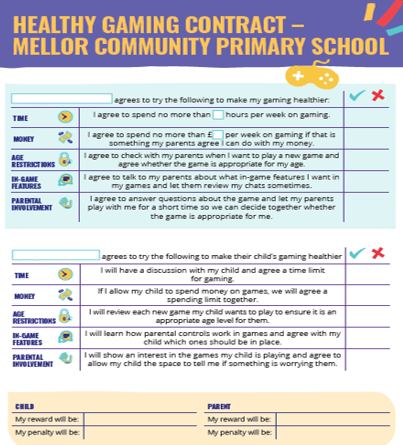
To provide lasting impact beyond the healthy gaming workshop, we developed the idea of a ‘Healthy Gaming Contract’ — a simple, co-created agreement that students could take home and use over the summer break.
Recognising the importance of shared ownership, we facilitated a focus group with students and parents to co-design a series of healthy gaming options. These were framed to encourage positive habits and meaningful boundaries, with students choosing the commitments they felt ready to make.
To support buy-in, we included a dedicated parent section to promote open communication around gaming and ensure boundaries were set and agreed collectively. Families were encouraged to set their own limits and choose a reward if both children and parents met their agreed goals.
The contract proved highly effective:
73% of students surveyed six months later said they felt confident they had stuck to their Healthy Gaming Contract
Six-month follow up
To determine the impact of our work, we surveyed the Year Five students at Mellor Community Primary School once they returned from their summer break.
We also ran a focus group with nine students to measure their knowledge retention and hear from them what difference the healthy gaming work had made on their lives.
The group showed an exceptional level of recall in a range of exercises designed to check whether they could identify what could cause harm in gaming, whether they can make informed choices about gaming, and if their views on gaming were being heard by the adults in their lives.
When asked about the healthy gaming contract, those who had used it (two thirds of the group) said they found setting time limits and money limits most useful in helping them create healthier gaming habits.
The survey findings showed improvements in all impact measures, apart from knowing where to get support if they were worried about their gaming.
Of the 16 students who reported feeling worried about their gaming over the summer, 12 of them reached out for support through their parents or a trusted adult. Two respondents said they used advice from the healthy gaming workshop to ease their concerns.
99% were confident making choices about gaming
Whilst we never asked this question in our pre-session survey, it was pleasing to hear that the students felt this level of confidence.
90% felt confident discussing gaming with adults
This increased from 78% when we asked this question in the pre-session survey, which marked a decent improvement in one of our key aims.
87% could identify how gaming causes harm to them or their family
One of the most significant achievements was getting students to realise that their gaming could also have a significant impact on their family and those close to them, with only 53% indicating they knew this pre-session.
74% were confident the adults in their life stuck to the contract
Whilst hearing that 73% of students felt they stuck to the healthy gaming contract, hearing that their parents were also engaging in it meant our whole-community approach had been working.

“I deleted Roblox because I couldn't stop playing it. I had been thinking about it and tried to delete it a few times but always came back to it. After the healthy gaming workshop, I have now deleted it and stayed away from it. Some of my friends have now done the same because they had similar issues. You guys have really helped.”
Mellor Community Primary School - Focus Group attendee, 10 years
Conclusions
- The healthy gaming pilot demonstrated the feasibility and value of a community-based approach to addressing gaming harm.
- The pilot successfully raised awareness of potential risks, equipped students with strategies to navigate the gaming landscape safely, and fostered open communication between students, staff, and (to a lesser extent) parents.
- Key findings highlight the prevalence of concerning gaming habits, including engagement with age-inappropriate content and excessive playtime, as well as the real-world impact of gaming-related harms like anger, relationship problems, and online safety issues.
- While the healthy gaming workshops and staff training were highly effective, parental engagement proved challenging and requires further exploration of alternative strategies.
- Crucially, the significant demand for student support underscores the need for accessible and ongoing resources.
- The six-month follow-up data suggests promising long-term impact on knowledge retention and behaviour, though the decline in awareness of support services emphasises the importance of reinforcement.
- Overall, the pilot program provides a strong foundation for wider national implementation, demonstrating the potential of the "Healthier Gaming" framework to mitigate gaming-related harms and promote responsible gaming practices.